Come Againg: 1Unpacking the Multifaceted Phrase Come Again
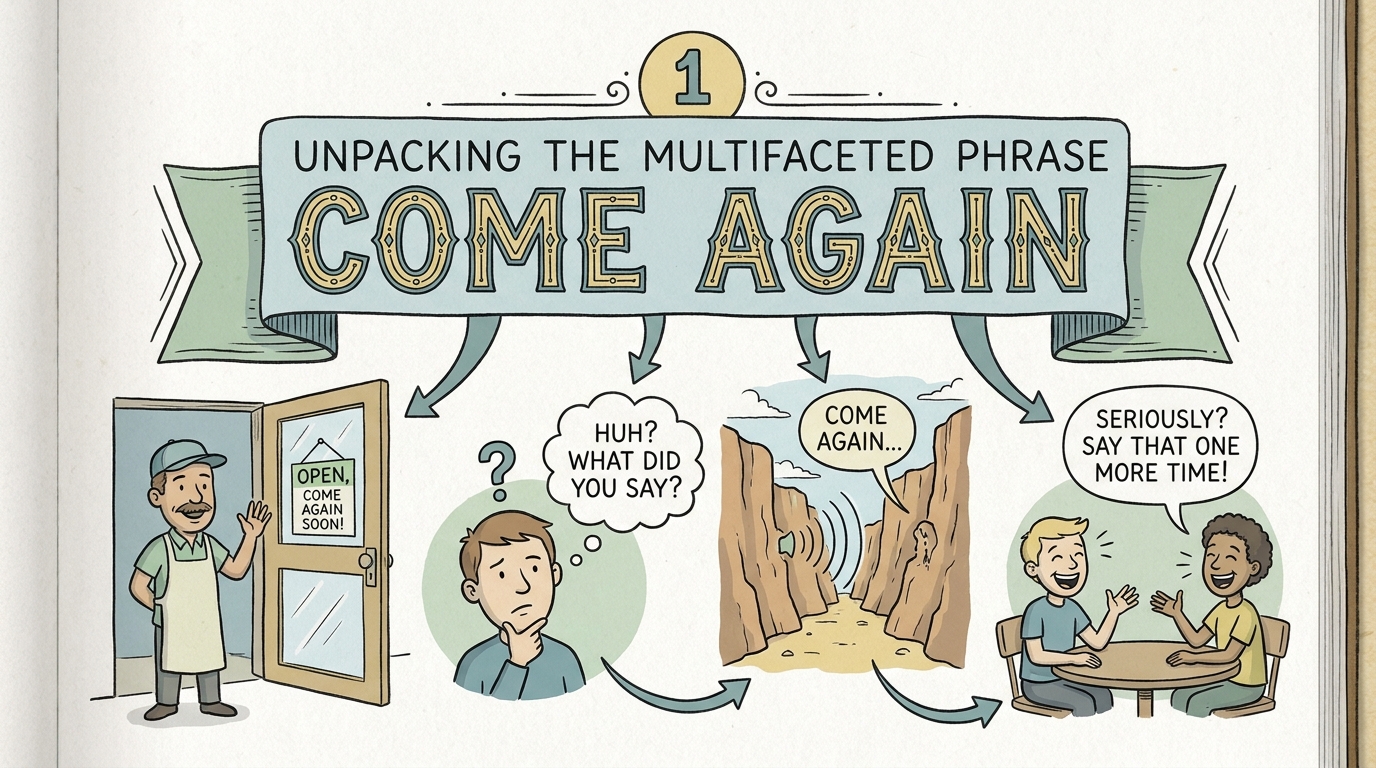
Table of Contents
Table of Contents
- The Literal and Invitatory “Come Again”
- “Come Again” as an Invitation: Hospitality and Customer Service
- “Come Again?”: The Query for Clarification and Disbelief
- The Nuances of Tone: From Politeness to Challenge
- Why We Ask “Come Again?”: Reasons for Seeking Repetition
- The Etymological Journey of “Come Again”
- “Come Again” in Professional Communication: Ensuring Clarity and Avoiding Misunderstandings
- Strategies for Effective Clarification Beyond “Come Again”
- The Broader Implications: Cycles, Repetition, and Second Chances
- Conclusion
Come againg, while a common typographical error, frequently serves as a gateway to exploring the rich and varied interpretations of the phrase “come again.” This seemingly simple two-word expression carries a surprising depth of meaning in the English language, transitioning from a literal request for physical return to a powerful, albeit informal, tool for seeking clarification or expressing incredulity. Understanding its multifaceted nature is crucial for navigating everyday conversations and appreciating the subtle nuances of communication.
The Literal and Invitatory “Come Again”
At its most fundamental, “come again” refers to the physical act of returning. This literal interpretation is straightforward and unambiguous, indicating a desire or instruction for someone to revisit a place or repeat an action. For instance, a host might say, “We had a wonderful time, please come again soon,” expressing a genuine wish for a guest’s return. This usage is polite, welcoming, and directly relates to the verb “to come” in its spatial or temporal sense. The phrase here signifies a second occurrence of an event or a return to a previous location. This understanding forms the bedrock from which its more idiomatic meanings have evolved, grounding the expression in tangible reality before its expansion into the realm of abstract communication. Its use in this context is often accompanied by a sense of warmth and hospitality, fostering positive interpersonal connections. Consider a shopkeeper bidding farewell to a customer with “Thank you for your business, come again,” which extends an open invitation for future patronage. This reinforces the commercial relationship and encourages repeat visits.
“Come Again” as an Invitation: Hospitality and Customer Service
Beyond personal invitations, the phrase “come again” is widely used in commercial and service-oriented environments. Here, it functions as a polite farewell, encouraging customers or visitors to return. It’s a staple in retail stores, restaurants, and other establishments where fostering repeat business is key. When a cashier says, “Thank you, come again,” it’s an expression of hope for future interaction, often delivered with a friendly demeanor. This usage is so ingrained in commercial etiquette that it often goes unnoticed, serving as a subtle yet effective mechanism for building customer loyalty. The implication is that the experience was positive enough to warrant a return visit, creating a welcoming atmosphere that extends beyond the immediate transaction. This form of “come again” is a cornerstone of good customer service, reinforcing positive interactions and maintaining an open channel for future engagement.
“Come Again?”: The Query for Clarification and Disbelief
Perhaps the most prevalent and intriguing use of “come again” is as an interjection, typically posed as a question (“Come again?”). In this context, it primarily serves two critical functions: requesting repetition or expressing surprise and disbelief. When someone says “Come again?” with an inquisitive tone, they are essentially asking, “Could you please repeat what you just said?” or “I didn’t hear you clearly.” This can stem from actual auditory difficulties, a momentary lapse in attention, or simply the complexity of the information being conveyed. It’s an informal way to signal that the message was not fully received or understood. However, the phrase also carries the weight of incredulity. If a statement is particularly outlandish, shocking, or hard to believe, “Come again?” can be uttered with a rising intonation to convey utter astonishment. In such instances, the speaker isn’t necessarily asking for a literal repetition because they didn’t hear; rather, they are expressing disbelief and prompting the other person to confirm or explain the surprising statement. This indicates that the listener heard the comment but struggles to accept its truth.
The Nuances of Tone: From Politeness to Challenge
The impact of “Come again?” is heavily dependent on vocal tone and context. While it can be a neutral or polite request for repetition, it can also border on impoliteness or even convey a subtle challenge. A soft, questioning “Come again?” usually signals a genuine need for clarification. However, a sharper, more abrupt “Come again?” can imply annoyance or a direct challenge to the speaker’s statement, suggesting that what was said is absurd or unacceptable. It is a more informal alternative to phrases like “Pardon me?” or “Excuse me?”. In some casual settings, it can be a quick and efficient way to manage a conversational blip, but in more formal environments, it might be perceived as brusque or disrespectful. The informality of “come again” means that in professional or formal settings, alternatives like “Could you please repeat that?” or “Would you mind clarifying?” are often preferred to maintain decorum and ensure no offense is taken.

Why We Ask “Come Again?”: Reasons for Seeking Repetition
The act of asking for repetition, whether with “come again?” or another phrase, is fundamental to effective communication. People ask for repetition for various reasons:
- Auditory Difficulty: The most straightforward reason is simply not hearing what was said due to noise, distance, or a speaker’s soft voice.
- Lack of Comprehension: Even if heard, a statement might be unclear, ambiguous, or contain unfamiliar vocabulary, prompting a request for rephrasing or simplification.
- Distraction: A momentary lapse in concentration can lead to missing crucial parts of a conversation.
- Disbelief or Surprise: As discussed, to convey shock or to prompt the speaker to reaffirm a surprising statement.
- Processing Time: Sometimes, a complex idea requires a moment to process, and asking for repetition can buy that time, allowing the listener to fully grasp the information.
In any case, asking for clarification demonstrates active listening and a commitment to understanding, which are vital for productive dialogue. It is an acknowledgment that effective communication is a two-way street, requiring both clear articulation from the speaker and diligent reception from the listener. Ignoring what one hasn’t understood, or pretending to understand, can lead to significant misunderstandings and errors.
The Etymological Journey of “Come Again”
The idiom “come again” is believed to have originated in the 19th century in America. Early usage suggests that the verb “come” was sometimes used interchangeably with “speak” by many Americans, particularly African Americans. This linguistic practice likely paved the way for “come again” to evolve into a shorthand for “speak again” or “say again.” The Oxford English Dictionary notes its earliest known use as “come-again” in the early 1600s, suggesting its roots might be deeper, although its idiomatic usage as a query for repetition solidified later. This evolution highlights how language adapts and repurposes existing words to create new, concise forms of expression that serve immediate communicative needs. The transition from a literal command to an idiomatic question illustrates the dynamic nature of English and its capacity for semantic shifts based on cultural and conversational patterns.
| Context of Use | Intended Meaning | Appropriate Tone | Common Alternatives |
|---|---|---|---|
| Farewell/Invitation | Please return/visit again. | Warm, polite, welcoming | “Hope to see you again,” “Please come back.” |
| Not Heard Clearly | Could you repeat that? | Inquisitive, neutral, slightly apologetic | “Pardon?”, “Excuse me?”, “Sorry, I didn’t catch that.” |
| Not Understood | Could you clarify/explain that? | Thoughtful, seeking comprehension | “Could you elaborate?”, “What do you mean?”, “I’m not sure I understand.” |
| Surprise/Disbelief | Did you really say that? | Astonished, incredulous, sometimes challenging | “Are you serious?”, “You’re joking, right?”, “I can’t believe it.” |
“Come Again” in Professional Communication: Ensuring Clarity and Avoiding Misunderstandings
In professional settings, the importance of clarity in communication cannot be overstated. While “come again?” is an effective informal phrase for clarification, its casual nature means it should be used with discretion in formal environments. Unclear instructions, vague feedback, or unspoken assumptions can lead to significant errors, missed deadlines, decreased productivity, and even damaged professional relationships. Asking for clarification, when done professionally, demonstrates strong listening skills, a commitment to accuracy, and a proactive approach to problem-solving. It helps to confirm expectations, align team members, and prevent rework. Leaders who encourage a culture of clarification foster trust and enhance collaboration within their teams.
Strategies for Effective Clarification Beyond “Come Again”
To ensure clear communication in professional and formal contexts, several strategies can be employed:
- Paraphrasing: Repeating the speaker’s message in your own words to confirm understanding. This shows engagement and allows the speaker to correct any misinterpretations.
- Asking Open-Ended Questions: Using “When,” “Where,” “How,” or “Why” questions encourages the speaker to elaborate and provide more detail.
- Requesting Specific Examples: If a concept is abstract, asking for a concrete example can bring clarity.
- Summarizing Key Points: Briefly recapping the main ideas discussed helps to ensure everyone is on the same page.
- Being Assertive: It is crucial not to shy away from asking for clarification, even if it feels uncomfortable. It is better to seek understanding than to proceed with incorrect assumptions. “I’m sorry, I find it really hard to hear with all this background noise!” or “I do apologise – my hearing must be going downhill, I still didn’t hear what you said!” are polite ways to ask for repetition, externalizing the issue rather than blaming the speaker or oneself.
- Using Clear and Direct Language: When communicating oneself, it’s essential to build substance, keep messages simple, create structure, and pace delivery to avoid necessitating frequent requests for clarification from others.
Effective clarification is a cornerstone of strong communication skills, reducing misalignments and fostering a more productive environment. It shows that you value what others have to say and are committed to accurate outcomes. For further insights into overcoming communication barriers and fostering clarity, resources like Wikipedia’s article on Communication offer a comprehensive overview of the subject, emphasizing the various components and challenges inherent in human interaction.
The Broader Implications: Cycles, Repetition, and Second Chances
Beyond its literal and idiomatic uses in daily conversation, the concept of “come again” resonates in broader, figurative senses, touching upon themes of repetition, cycles, and second chances. In literature, philosophy, and everyday contemplation, the idea of things “coming again” speaks to the cyclical nature of life, seasons, opportunities, and even historical events. “Don’t miss this opportunity: it may never come again,” is a common adage that uses the phrase to emphasize the unique and sometimes fleeting nature of certain moments. This metaphorical extension of “come again” imbues the phrase with a deeper, often poignant, meaning. It can evoke hope, as in the anticipation of spring’s return or the possibility of a better tomorrow. Conversely, it can carry a sense of loss or regret, lamenting what has passed and will not be revisited. The phrase can also be used to highlight persistence, the idea that despite setbacks, one will “come again” to achieve a goal or make an impact. This speaks to resilience and the human spirit’s capacity for renewal and continued effort. In these contexts, “come again” transcends its conversational utility to become a comment on the fabric of existence itself, reflecting on recurring patterns and the potential for new beginnings.
Conclusion
Come againg, or rather, “come again,” is a remarkably versatile phrase in the English language. From its straightforward invitation for a return visit to its nuanced role as a query for clarification or an expression of disbelief, its meaning is heavily shaped by context, intonation, and intent. While its informal nature dictates careful use in professional settings, its underlying function—to ensure understanding and manage conversational flow—remains universally important. Recognizing the various facets of “come again” enhances not only our linguistic comprehension but also our appreciation for the subtle yet profound ways in which language shapes our interactions and understanding of the world. Mastering the art of clarification, whether through this concise idiom or more formal strategies, is an indispensable skill for effective communication in all spheres of life, fostering stronger connections and mitigating misunderstandings.