7 Senior Citizen Age Rules & Benefits – Positive Global Impact

Table of Contents
Senior Citizen status, a universally recognized phase of life, is often associated with the culmination of a productive working career and the commencement of a period dedicated to rest, leisure, and personal fulfillment. However, the precise age at which one officially becomes a ‘senior citizen’ and the array of benefits accompanying this designation can vary significantly across different countries and cultures. While a common understanding often places this milestone around 60 or 65, legal definitions, societal expectations, and the specific benefits offered are deeply rooted in each nation’s socio-economic structure and cultural values. Understanding these diverse rules and benefits is crucial for individuals approaching this life stage, as well as for policymakers and caregivers worldwide.
Understanding the Senior Citizen Designation
The concept of a ‘senior citizen’ extends beyond a mere chronological age; it embodies a recognition of an individual’s accumulated life experience, contributions to society, and often, a transition into a new phase of life that may involve retirement, reduced working hours, or a focus on personal well-being. Globally, there isn’t a single, universally accepted age to define a senior citizen, though international bodies often provide guidelines. The United Nations, for instance, generally defines “older persons” as those aged 60 years or over. However, this definition can be influenced by various factors, including life expectancy, health status, and economic conditions within a specific region or country. Some programs and discounts might consider individuals as seniors as early as 50 or 55, while official government benefits often kick in later.
Different countries employ varying criteria, with some relying on chronological age (e.g., 65 in the US), others on functional age (ability to perform daily activities), and still others on life stage age (reaching milestones like retirement or grandparenthood). Policy age, defined by eligibility for specific programs like Medicare at 65 in the US, is another common classification. This fluid definition highlights the diverse ways societies perceive and integrate their older populations.
Global Perspectives on Retirement Age and Senior Status
The age at which individuals are considered eligible for retirement pensions and other senior benefits is a critical determinant of senior citizen status. This age is not static and is often subject to change based on economic pressures, demographic shifts, and evolving national policies. For example, in many Western countries, the threshold is often 65 years, coinciding with retirement and pension benefits. However, this is not a universal standard, and many countries are gradually increasing their retirement ages to ensure the sustainability of their pension systems due to rising life expectancies and shrinking birth rates.
- In the United States, a senior citizen is typically defined as someone 65 years or older, aligning with eligibility for Social Security and Medicare. However, individuals can start claiming Social Security retirement benefits as early as 62, albeit with permanently reduced payments, while full retirement age is between 66 and 67 depending on the birth year.
- Canada generally recognizes individuals aged 65 and older as senior citizens, making them eligible for the Old Age Security (OAS) program. The Canada Pension Plan (CPP) retirement pension, however, can be accessed as early as age 60, with increased benefits for those who delay claiming.
- In the United Kingdom, the State Pension age is currently 66, but this is set to rise to 67 between 2026 and 2028. However, some benefits and concessions, like free prescriptions and NHS eye tests, begin at age 60.
- Australia’s age pension is available between 66 and 67, as of July 2023, with eligibility for the Commonwealth Seniors Health Card beginning at 67.
- Germany is gradually raising its standard retirement age from 65 to 67 for those born after 1964.
- Japan, a global leader in longevity, categorizes individuals 65 and over as elderly, with the basic pension also generally starting at 65. However, early payment of the Old-age Basic Pension is possible from age 60 with reduced benefits.
- India legally defines a senior citizen as anyone aged 60 years and above, granting them eligibility for various benefits.
- Brazil’s Estatuto do Idoso (Statute of the Elderly) grants a range of rights and privileges to those aged 60 and above, with the Continuous Provision Benefit (BPC) for vulnerable elderly individuals available at 65 and older.
Benefits for Senior Citizens: Social Security and Pensions
Pension and social security systems are fundamental pillars of support for senior citizens worldwide, providing a steady income stream post-retirement. These systems are designed to replace a portion of pre-retirement earnings, ensuring financial stability in later life. The structure and generosity of these systems vary considerably from country to country, often categorized into different “pillars” such that statutory pensions, earnings-related pensions, and private savings contribute to an individual’s retirement income.
- In the United States, Social Security benefits provide monthly income to retirees, with the amount dependent on an individual’s earnings history and the age at which they claim benefits.
- Canada’s retirement income system comprises the Old Age Security (OAS) and the Canada Pension Plan (CPP). OAS is a monthly benefit for Canadians aged 65 or older, funded by general tax revenues, while CPP is a contributory plan based on employment history.
- The United Kingdom’s State Pension provides a regular payment from the government once an individual reaches State Pension age, with the amount depending on National Insurance contributions. Pension Credit is also available for low-income seniors to top up their weekly income.
- Japan’s social security system includes the Old-age Basic Pension and earnings-related employee pensions. The system is comprehensive, with roughly 50% of social security benefits going towards pensions. Japan also offers “Additional Pension for Dependents” and “Old-Age Pensioner’s Supplementary Benefit” for certain low-income individuals.
- In Brazil, the Continuous Provision Benefit (BPC) guarantees a monthly minimum wage for elderly individuals aged 65 and older who are in vulnerable situations and meet specific income criteria.
Healthcare and Medical Concessions for Seniors
Access to affordable and comprehensive healthcare is a paramount concern for senior citizens globally. Many governments implement specific programs and concessions to ensure their older populations receive the medical care they need without undue financial burden. These can range from universal healthcare access to specialized insurance programs and prescription drug assistance.
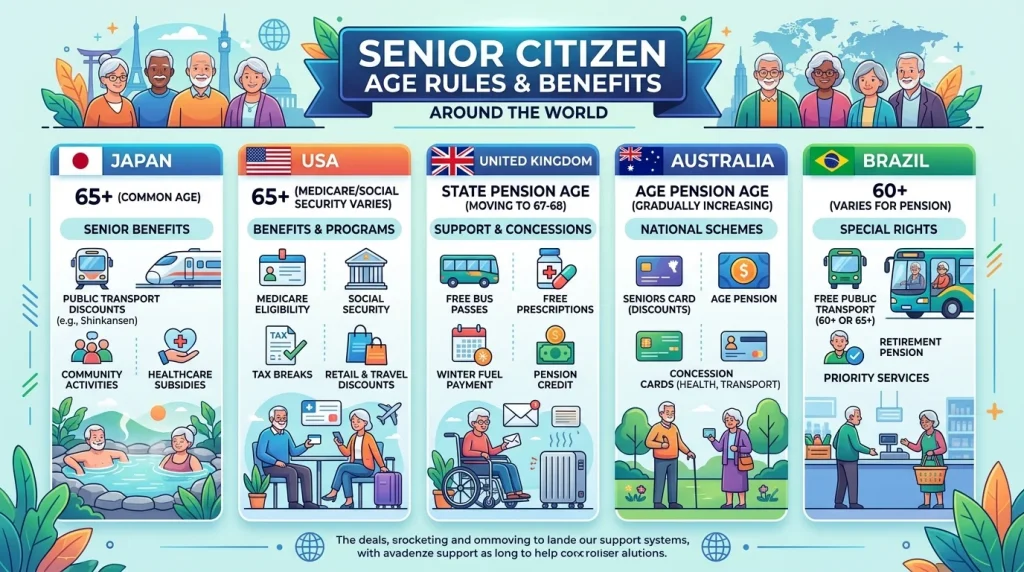
- The United States offers Medicare, a federal health insurance program for individuals aged 65 and older, covering hospital insurance (Part A), medical insurance (Part B), and prescription drug coverage (Part D). Additionally, Medicare Savings Programs can help low-income seniors with premiums, deductibles, and co-payments.
- In Canada, universal healthcare covers most medical services, with provincial drug plans often covering prescription medications for seniors at little or no cost.
- United Kingdom residents over 60 are entitled to free NHS eye tests and free prescriptions in England. Free dental treatment may also be available for those claiming certain benefits.
- Japan has one of the most generous long-term care systems globally, with comprehensive coverage and benefits to enable seniors to live autonomously. The country also has a robust social security system that dedicates about 30% of its benefits to medical subsidies.
- India provides priority healthcare services and special schemes for senior citizens.
- Brazil’s National Health Policy for the Elderly ensures comprehensive health care through the public health network, including access to treatment, prostheses, wheelchairs, glasses, and hearing aids. Free medications are also available through government programs.
Transportation and Housing Benefits
Ensuring mobility and stable, affordable housing are critical aspects of supporting senior citizens. Many countries offer various concessions to ease these burdens, allowing seniors to maintain independence and quality of life.
| Country | Senior Citizen Age for Key Benefits | Primary Pension/Social Security | Healthcare Benefits (Examples) | Transportation Benefits (Examples) | Housing Benefits (Examples) |
|---|---|---|---|---|---|
| United States | 65 (Medicare, Full Social Security); 62 (Early SS) | Social Security | Medicare (Part A, B, D); Medicare Savings Programs | Amtrak discounts (65+), National Park lifetime pass (62+) | HUD Section 202 (62+), Section 8 vouchers, tax credit apartments (55-62+) |
| Canada | 65 (OAS); 60 (CPP) | Old Age Security (OAS), Canada Pension Plan (CPP) | Provincial drug plans, subsidies for home care | Discounts/subsidies on transit passes | Subsidized housing, property tax deferral |
| United Kingdom | 66 (State Pension); 60 (Free prescriptions, eye tests) | State Pension, Pension Credit | Free NHS eye tests (60+), free prescriptions (60+ in England) | Free bus pass (State Pension age), Senior Railcard (60+) | Council Tax Reduction, Winter Fuel Payment, Housing Benefit |
| Australia | 67 (Age Pension, Commonwealth Seniors Health Card) | Age Pension, Superannuation | (Universal healthcare system – Medicare) | Concessions on public transport (state-specific) | Rent assistance, utility concessions (state-specific) |
| Germany | 67 (Full Pension for those born after 1964) | Statutory Pension Insurance | (Universal healthcare system) | Varying discounts at 60+ (context-dependent) | Housing allowance for low-income seniors |
| Japan | 65 (Old-age Basic Pension); 60 (Early pension option) | Old-age Basic Pension, Employees’ Pension | Generous Long-Term Care Insurance, medical subsidies | Senior discounts on transportation services | Support for independent living, long-term care facilities |
| India | 60 (Legal definition, benefits eligibility) | Pensions for eligible individuals | Priority healthcare services | Railway and bus travel concessions | Schemes for affordable housing |
| Brazil | 60 (Estatuto do Idoso); 65 (BPC) | Continuous Provision Benefit (BPC) | Comprehensive public health care, free medications | Free urban transport (65+), half-price tickets for events | IPTU exemption (property tax) in some cities |
- In the United States, seniors can find travel deals, including discounted Amtrak fares for those 65 and older and a National Park Service lifetime pass for those 62 and older. Housing assistance programs such as HUD’s Section 202 Supportive Housing for the Elderly and Section 8 Housing Choice Vouchers provide affordable rental options for low-income seniors, often with age eligibility starting at 62 or 55.
- Canada offers subsidized housing programs (rent-geared-to-income) and property tax deferral options in some provinces to help seniors remain in their homes. Discounts or subsidies on transit passes and utility assistance are also available.
- The United Kingdom provides a free bus pass for those over State Pension age for off-peak travel and a Senior Railcard for individuals over 60, offering a 33% discount on rail travel. Housing benefits, such as Council Tax Reduction, also help low-income seniors manage living costs.
- Brazil stands out with significant transportation benefits, including free urban transport for individuals aged 65 and older and half-price tickets for events. Many Brazilian cities also offer exemptions from property tax (IPTU) for eligible elderly individuals, particularly those with low income who own a single residential property.
- India provides railway and bus travel concessions for senior citizens.
- Japan offers senior discounts on various transportation services and attractions.
Tax Relief and Financial Assistance Programs
Beyond pensions and direct healthcare support, many countries offer various forms of financial relief and assistance to senior citizens, recognizing their often fixed incomes and potential for increased expenses. These can include tax exemptions, special benefits for low-income individuals, and support for specific needs.
- In the United States, seniors may benefit from tax deductions and specific retirement account limits. Additionally, the Tax Counseling for the Elderly (TCE) Program provides free tax help to people aged 60 and older. Supplemental Security Income (SSI) offers cash assistance to low-income individuals aged 65 or older, or those who are blind or disabled.
- Canada provides the Guaranteed Income Supplement (GIS) for low-income OAS recipients, and provincial programs like the Alberta Seniors Benefit. Tax credits for caregivers and home adaptations for seniors’ independence are also available.
- The United Kingdom offers Pension Credit, a means-tested benefit designed to provide financial assistance to low-income elderly individuals. Other benefits include the Winter Fuel Payment and, for those aged 80 and over, an ‘over 80’ pension that can top up weekly amounts.
- Brazil provides an additional exemption bracket in the Income Tax for retirees and pensioners over 65, significantly increasing their disposable income. The Continuous Provision Benefit (BPC) is a key financial assistance program for vulnerable elderly individuals.
- India offers higher tax exemption limits and higher interest rates on savings schemes for senior citizens.
- Japan has implemented major pension reforms to raise the earnings threshold for pension reduction for working seniors and offers benefits like the “Re-employment Allowance” and “Continued Employment Benefit for the Elderly” for working seniors whose wages have fallen.
Country Spotlight: Diverse Approaches to Senior Support
While the benefits mentioned are common categories, the specifics and the philosophy behind senior support systems vary widely. The Mercer CFA Institute Global Pension Index, for example, benchmarks 52 retirement income systems worldwide, assessing them based on adequacy, sustainability, and integrity. Countries like the Netherlands, Iceland, and Denmark consistently rank high for their robust and sustainable pension systems.
Japan, facing the world’s most rapidly aging and shrinking population, is a frontrunner in adapting its infrastructure and social policies. The government actively encourages employment opportunities for older adults and has made significant efforts to assist job placement and extend the retirement age. They also invest heavily in long-term care systems and utilize technology, such as robots, to address healthcare and nursing needs. This holistic approach underscores a national commitment to enabling a healthier, more productive, and engaged older population. The Japanese long-term care insurance system, which requires everyone over 40 to be insured, is a testament to this proactive approach.
Brazil’s “Estatuto do Idoso” (Statute of the Elderly), enacted in 2003, is a comprehensive federal law designed to guarantee dignity, social participation, and a good quality of life for everyone aged 60 and above. This statute provides a robust legal framework, granting priority treatment in public and private facilities, legal proceedings, and access to essential services. For those aged 80 and over, there’s a designated “superpriority” status, ensuring they receive precedence even among other seniors. This highlights a strong cultural and legal emphasis on respecting and supporting elders.
Similarly, the United States has the Older Americans Act (OAA), which provides a broad range of community-based social services, including meal programs, transportation, caregiver support, and health promotion services. These programs are crucial for maintaining the independence and well-being of older adults.
For more detailed global comparisons and insights into pension systems, resources like the Mercer CFA Institute Global Pension Index provide invaluable data on how different countries are addressing the challenges and opportunities of an aging population. This allows for a deeper understanding of the strengths and weaknesses of various approaches to retirement security and elder care.
Conclusion: A World United in Valuing its Elders
The landscape of senior citizen age rules and benefits around the world is a complex tapestry, woven with diverse cultural values, economic realities, and policy priorities. While the specific age for gaining ‘senior’ status and the nature of accompanying benefits may differ significantly from one country to another, a common thread unites these nations: a recognition of the importance of supporting and valuing their older populations. From comprehensive pension schemes and universal healthcare access to targeted transport concessions, housing assistance, and tax relief, governments globally are striving to ensure their seniors can live with dignity, security, and a continued sense of belonging. As global populations continue to age, the evolution of these rules and benefits will remain a critical area of focus, underscoring society’s ongoing commitment to its elders.